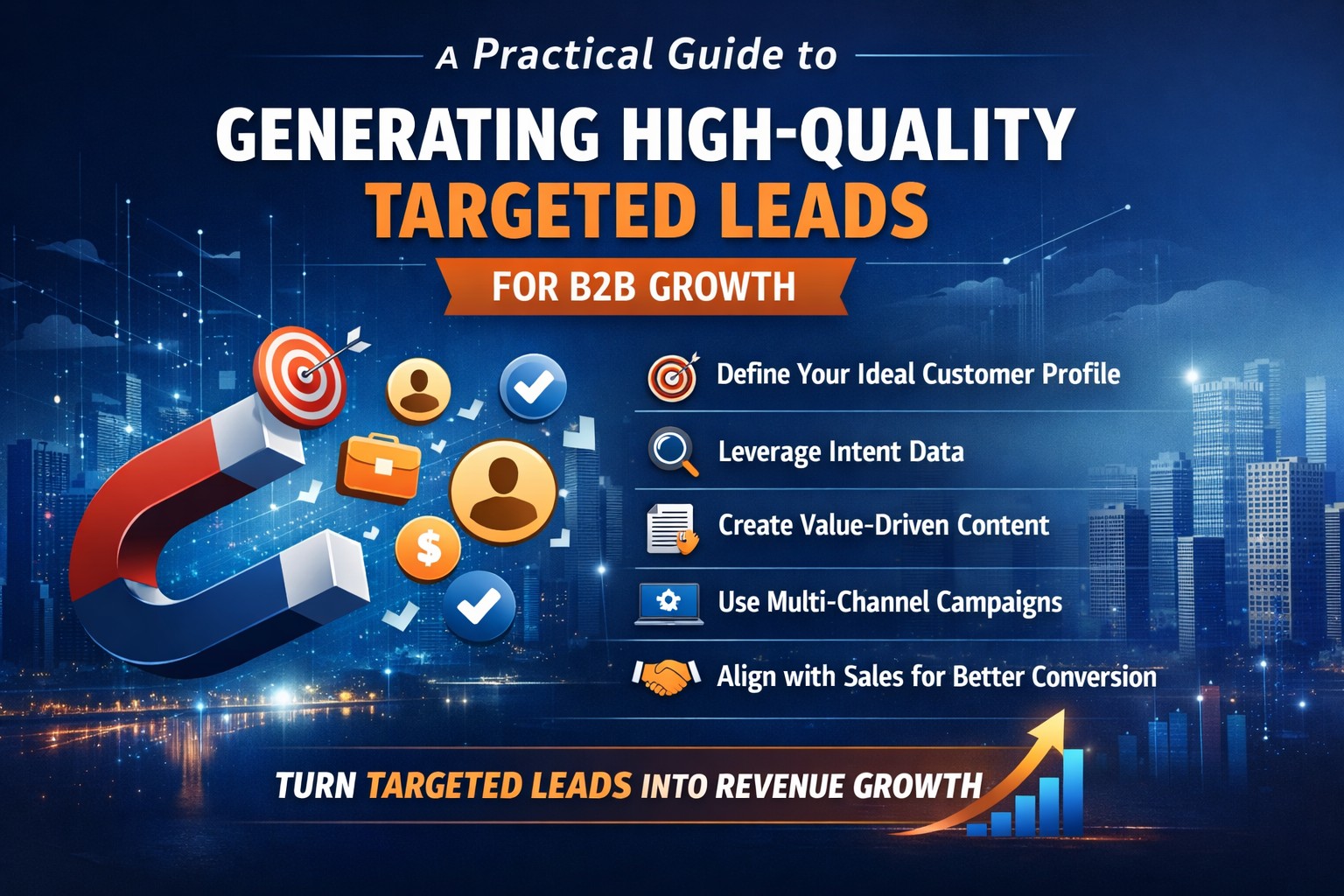
A Practical Guide to Generating High-Quality Targeted Leads for B2B Growth
Generating leads is easy. Generating high-quality, targeted leads that convert into pipeline and revenue? That’s where most B2B teams struggle.
In today’s environment, volume alone doesn’t drive growth. Sales teams don’t need more names—they need accounts that fit, show intent, and are ready to engage. This guide breaks down how to build a practical, repeatable system for generating leads that actually turn into revenue.
Step 1: Define Your Ideal Customer Profile (ICP)
Everything starts with clarity.
Before launching campaigns, define:
Industry and sub-industry
Company size and revenue range
Geographic focus
Technology environment (if relevant)
Common pain points
Buying committee structure
Look at your best existing customers. What patterns do you see? High-quality leads come from replicating proven fit—not guessing.
Without a strong ICP, even the best campaigns will attract the wrong audience.
Step 2: Align Marketing and Sales Early
High-quality lead generation requires shared definitions.
Agree on:
What qualifies as an MQL
What signals indicate sales readiness
Target accounts or verticals
Follow-up timelines
Feedback loops on lead quality
If marketing and sales define “qualified” differently, growth stalls.
Step 3: Use Intent Signals to Improve Timing
Targeting the right account is only half the equation. Timing matters just as much.
Layer in intent signals such as:
Topic research behavior
Content engagement patterns
Website visits to high-value pages
Competitor comparison activity
Intent data helps prioritize accounts actively researching solutions—not just those that match your ICP.
High-quality leads come from fit + readiness.
Step 4: Offer Value-Driven Content That Solves Real Problems
Modern B2B buyers are self-directed. They don’t want generic pitches—they want insight.
High-performing lead magnets include:
Industry research reports
Solution guides and comparison frameworks
Case studies with measurable results
ROI calculators or interactive tools
Educational webinars
Avoid overly promotional content. Educational, problem-solving assets attract buyers who are thinking strategically.
Step 5: Use Multi-Channel Distribution
Relying on a single channel limits reach and consistency. High-quality lead generation works best when multiple channels reinforce each other.
Effective channels include:
LinkedIn and account-based ads
Content syndication
Email marketing
Retargeting campaigns
Webinars and virtual events
Partner and industry media placements
Consistency across touchpoints builds familiarity and trust.
Step 6: Optimize Forms Without Killing Conversion
Forms are necessary—but they shouldn’t create friction.
Best practices:
Ask only for essential information
Use progressive profiling over time
Be transparent about follow-up
Balance qualification with user experience
Overly long forms reduce completion rates and damage trust. Focus on quality signals beyond just data fields.
Step 7: Prioritize Buying Committee Coverage
High-quality B2B leads rarely come from a single contact. Deals often involve multiple stakeholders.
Track:
How many roles from a target account are engaging
Whether both technical and executive personas are involved
Cross-departmental interest
When multiple stakeholders engage, lead quality increases significantly.
Step 8: Nurture Before You Push
Not every targeted lead is ready to talk to sales immediately.
Build structured nurture sequences that:
Deliver stage-relevant content
Address objections early
Reinforce ROI and differentiation
Provide gradual escalation toward sales engagement
Lead quality improves when prospects are educated before handoff.
Step 9: Measure What Actually Matters
Avoid vanity metrics. High-quality lead generation should be measured by revenue impact.
Track:
MQL-to-SQL conversion rate
Opportunity creation rate
Win rate by channel
Pipeline contribution
Average deal size
Sales cycle length
If leads aren’t influencing pipeline, they’re not high quality.
Common Mistakes to Avoid
Chasing volume over fit
Ignoring timing and intent
Treating lead generation as marketing-only
Failing to follow up quickly
Measuring success by cost per lead alone
Growth comes from relevance, alignment, and consistency—not shortcuts.
Final Thoughts
High-quality targeted lead generation isn’t about doing more—it’s about doing the right things intentionally.
The formula is straightforward:
Clear ICP + Intent Signals + Value-Driven Content + Multi-Channel Execution + Sales Alignment = Predictable B2B Growth
When this system is refined and repeated, lead quality improves, pipeline strengthens, and growth becomes sustainable—not accidental.
Read More: https://intentamplify.com/blog..../what-are-targeted-l