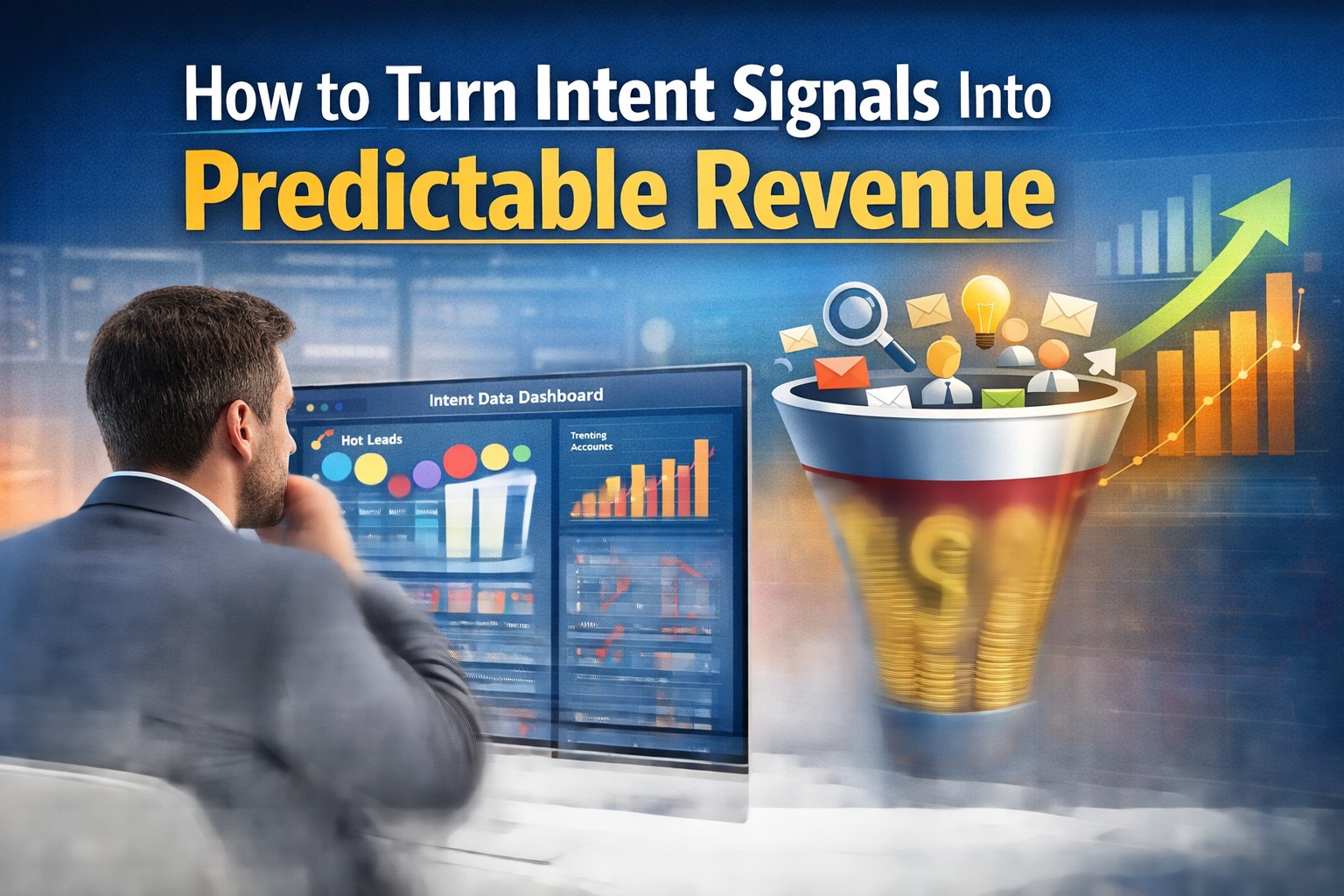
How to Turn Intent Signals Into Predictable Revenue
Intent data is one of the most powerful tools in modern B2B marketing—but only if it’s activated correctly. Too often, teams collect intent signals, run reports, and generate lists… without turning those insights into consistent pipeline.
The real opportunity isn’t spotting interest. It’s converting intent into predictable revenue.
Here’s how to do it.
Step 1: Define What “High Intent” Actually Means
Not all intent signals are equal. A single content view is not the same as repeated research across competitor comparisons, pricing pages, and solution-specific topics.
Start by defining clear tiers of intent:
Low Intent: Educational content consumption, broad topic research
Mid Intent: Solution-category research, webinar engagement, whitepaper downloads
High Intent: Pricing page visits, competitor comparison engagement, multiple stakeholders researching simultaneously
Without signal prioritization, teams chase noise instead of readiness.
Step 2: Combine Intent with ICP Fit
Intent without qualification can waste time. A small company researching your category may never convert if it doesn’t match your ideal customer profile (ICP).
To turn signals into revenue, layer:
Firmographics (industry, company size, revenue)
Technographics (existing tech stack)
Role and seniority
Geographic alignment
The sweet spot is high intent + high fit. That’s where predictable pipeline begins.
Step 3: Act Fast—Timing Is Everything
Intent signals decay quickly. If an account is actively researching today, waiting two weeks to follow up reduces your advantage.
Create workflows that:
Automatically notify sales of high-intent accounts
Trigger personalized outreach sequences
Serve dynamic ads aligned to observed research topics
Deliver contextual email content within days—not weeks
Speed compounds conversion probability.
Step 4: Personalize Based on Observed Behavior
Generic outreach wastes intent data.
If an account is researching:
AI infrastructure → speak to scalability and integration
Cost optimization → highlight ROI and efficiency
Security risks → focus on compliance and risk mitigation
Behavior-based messaging increases response rates because it aligns with what buyers already care about.
Intent data should guide the narrative—not just the target list.
Step 5: Align Sales and Marketing Around Signals
Intent data works best when sales and marketing operate from the same playbook.
Key actions:
Agree on signal thresholds for outreach
Share dashboards with account engagement insights
Track which signals correlate with closed-won deals
Build feedback loops between reps and marketers
Revenue predictability increases when teams treat intent as shared intelligence, not marketing-only data.
Step 6: Use Intent to Accelerate Existing Pipeline
Intent isn’t just for net-new accounts. It can also strengthen active deals.
For example:
If a stalled opportunity shows renewed research activity, re-engage immediately
If new stakeholders from the same account begin researching, expand outreach
If competitor-related signals spike, address differentiation proactively
Intent signals can shorten sales cycles by reactivating momentum.
Step 7: Build Predictive Models Around Historical Data
To make revenue predictable, analyze past performance.
Ask:
Which intent patterns preceded closed deals?
How many engaged stakeholders were typically involved?
What was the average signal-to-opportunity timeline?
Use these patterns to create scoring models that forecast likelihood to convert.
Over time, intent becomes not just reactive insight—but predictive intelligence.
Step 8: Measure Revenue Impact, Not Just Engagement
It’s easy to celebrate increased engagement. But engagement doesn’t equal revenue.
Track:
Intent-qualified accounts to opportunity rate
Opportunity creation velocity
Win rates for high-intent accounts
Average deal size influenced by intent signals
Pipeline value sourced from intent-driven campaigns
Revenue predictability comes from measuring outcomes—not just activity.
Common Mistakes to Avoid
Acting on single data points instead of patterns
Treating all intent signals as urgent
Ignoring buying committee coverage
Delaying follow-up
Using generic messaging despite behavioral insights
Intent data amplifies strategy—but it doesn’t replace it.
The Bigger Shift: From Reactive to Proactive Revenue
The companies turning intent into predictable revenue share a mindset shift:
They don’t wait for inbound form fills.
They don’t rely solely on cold outreach.
They don’t guess when buyers are ready.
They monitor buying behavior continuously and respond in real time.
Final Thoughts
Intent signals are early indicators of demand—but they only become predictable revenue when paired with speed, personalization, alignment, and measurement.
The formula is simple:
Right Account + Right Signal + Right Timing + Right Message = Higher Conversion Probability
When this system is refined and repeated, revenue becomes less random—and far more predictable.
Read More: https://intentamplify.com/blog..../turning-intent-data