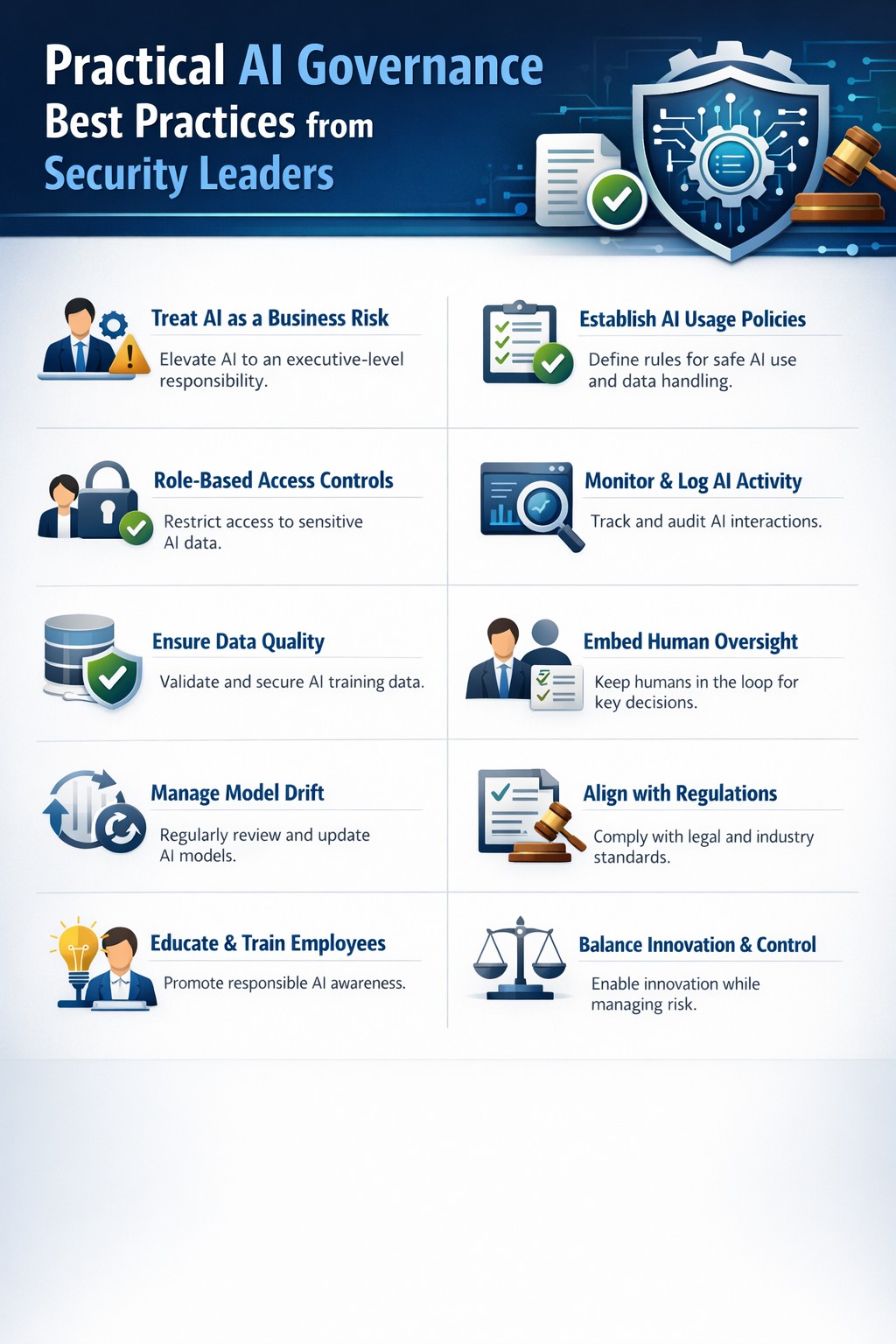
Practical AI Governance Best Practices from Security Leaders
As AI adoption accelerates across enterprises in 2026, governance has moved from theoretical discussion to operational necessity. Security leaders are no longer asking whether AI should be governed—they’re building frameworks that ensure AI systems are secure, compliant, ethical, and aligned with business objectives.
The most effective organizations are not overengineering governance. Instead, they are implementing practical, scalable controls that balance innovation with risk management. Below are the most important best practices emerging from security and risk leaders across industries.
1. Treat AI as a Business Risk, Not Just a Technical Tool
One of the biggest shifts in AI governance is recognizing that AI is not just an IT project—it’s a business risk surface. AI systems influence decisions, customer interactions, financial outcomes, and regulatory exposure.
Security leaders recommend:
Elevating AI governance to executive-level visibility
Assigning clear ownership (CISO, Chief Data Officer, or AI Risk Lead)
Integrating AI risk into enterprise risk management frameworks
AI governance works best when it’s tied to business impact, not just model accuracy.
2. Establish Clear AI Usage Policies Early
Before deploying AI tools widely, organizations should define clear guardrails around usage.
Practical policies include:
Approved vs. prohibited AI tools
Data classification rules for AI inputs
Restrictions on uploading sensitive data to public models
Rules around human oversight and final decision-making
Clear policies prevent shadow AI and reduce the likelihood of accidental data exposure.
3. Implement Role-Based Access Controls (RBAC)
AI systems often interact with highly sensitive data. Security leaders emphasize that AI outputs should respect the same access rules as the underlying data sources.
Best practices:
Enforce least-privilege access
Ensure AI-generated responses are permission-aware
Integrate AI systems with identity and access management (IAM) platforms
If an employee shouldn’t see certain data in a database, they shouldn’t be able to access it via AI either.
4. Monitor and Log AI Activity
Visibility is critical. AI systems must be auditable.
Security leaders recommend:
Logging AI queries and outputs
Monitoring unusual access patterns
Tracking model performance over time
Establishing alerting mechanisms for anomalies
This enables incident response teams to detect misuse, data leakage, or unintended behavior early.
5. Validate Data Sources and Model Inputs
AI systems are only as reliable as the data they use. Governance programs should include controls around data quality and provenance.
Key actions:
Maintain documentation of training data sources
Regularly audit datasets for bias or inaccuracies
Validate integration pipelines for security gaps
Enforce encryption for data in transit and at rest
Poor data governance leads to unreliable AI—and unreliable AI leads to business risk.
6. Embed Human Oversight Where It Matters
Despite advances in AI autonomy, security leaders strongly advocate for human-in-the-loop oversight in high-impact decisions.
Examples include:
Financial approvals
Healthcare recommendations
Legal document review
Security incident triage
Human oversight reduces liability and builds organizational trust in AI systems.
7. Plan for Model Drift and Continuous Review
AI governance isn’t a one-time setup. Models evolve—and so do risks.
Best practices include:
Regular model performance reviews
Drift detection and retraining protocols
Scheduled bias audits
Version control and rollback capabilities
Security leaders treat AI systems like living systems that require ongoing monitoring and adjustment.
8. Align Governance with Regulatory Requirements
AI regulations are expanding globally. Governance frameworks must account for:
Data protection laws
Industry-specific compliance requirements
Emerging AI accountability regulations
Audit and reporting obligations
Proactive alignment reduces future legal exposure and simplifies compliance.
9. Educate Employees on Responsible AI Use
Technology controls alone are insufficient. Employees need to understand:
What AI tools are approved
What data is safe to use
How to identify risky AI outputs
When to escalate concerns
Security leaders consistently cite training and awareness as one of the most effective risk mitigation tools.
10. Balance Innovation with Guardrails
The most successful AI governance programs avoid extremes. Overly restrictive controls slow innovation; overly permissive environments create risk.
The practical approach:
Start with high-risk use cases
Pilot governance frameworks before scaling
Collect feedback from business units
Iterate policies as AI maturity grows
Governance should enable responsible experimentation—not block it.
Final Thoughts
Practical AI governance in 2026 is about clarity, visibility, and accountability. Security leaders are building frameworks that protect data, manage risk, and maintain trust—while still allowing AI to drive innovation and operational gains.
Organizations that treat governance as a strategic enabler rather than a compliance burden will be best positioned to scale AI safely and sustainably in the years ahead.
Read More: https://technologyaiinsights.c....om/ai-governance-mad