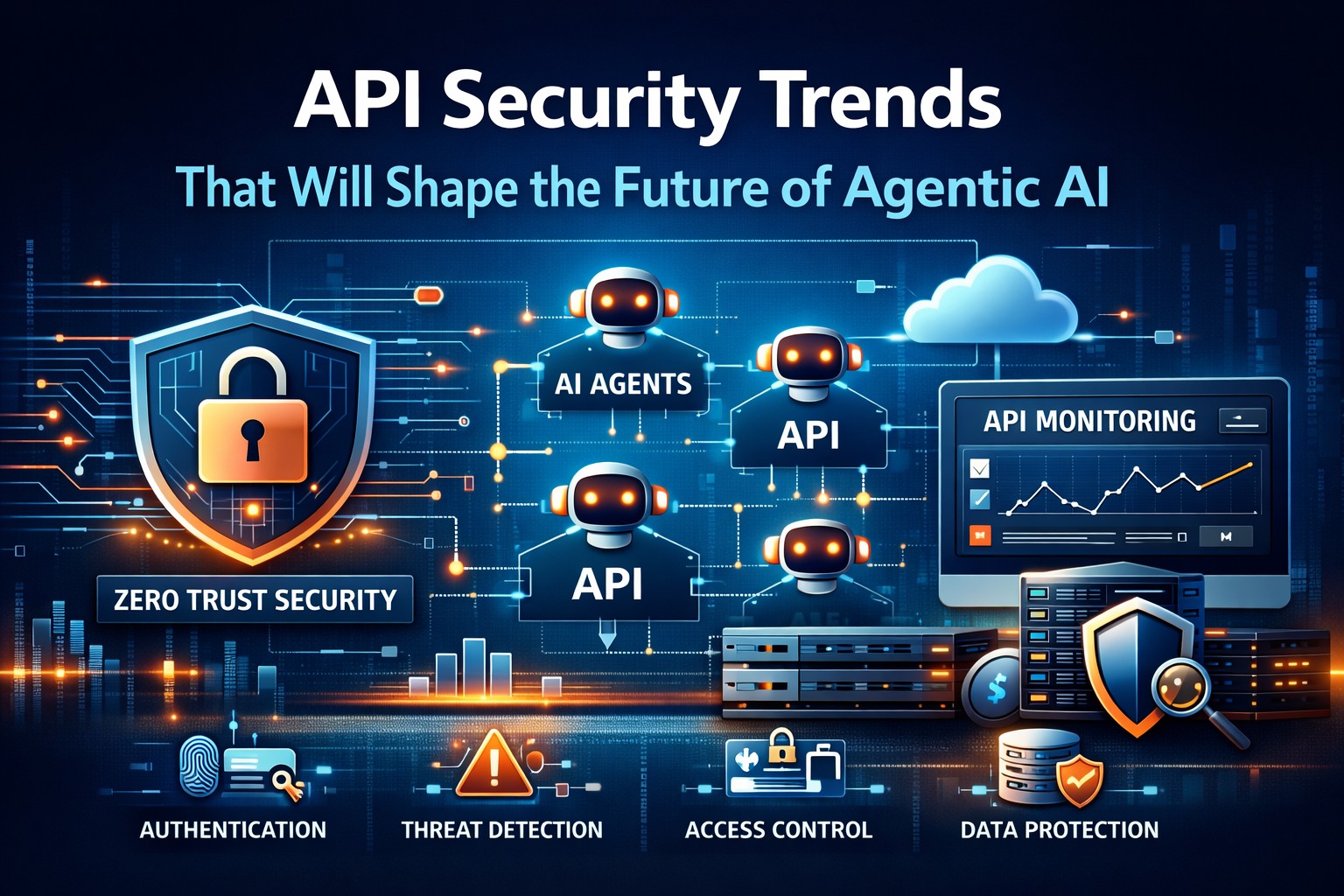
API Security Trends That Will Shape the Future of Agentic AI
Agentic AI—systems made up of autonomous or semi-autonomous AI agents that plan, decide, and execute tasks across tools—depends heavily on APIs. APIs are the connective tissue that allow AI agents to retrieve data, trigger workflows, access SaaS platforms, and orchestrate business processes.
As agentic AI adoption accelerates in 2026 and beyond, API security is no longer just an IT concern—it’s foundational to safe AI deployment. The way organizations secure APIs today will directly shape how confidently they can scale autonomous systems tomorrow.
Here are the key API security trends defining the future of agentic AI.
1. Zero-Trust Architecture Becomes the Default
Agentic AI systems frequently access multiple internal and external APIs across distributed environments. Traditional perimeter-based security models can’t handle this dynamic behavior.
In response, organizations are adopting zero-trust API security, which assumes:
No implicit trust between systems
Continuous verification of identity and context
Least-privilege access by default
For AI agents, this means every API call must be authenticated, authorized, and contextually validated—just like a human user would be.
2. Fine-Grained, Role-Aware Access Controls
Agentic AI often operates with machine identities rather than human ones. This creates new challenges: what permissions should an AI agent have? How long should they last?
Modern API security is shifting toward:
Short-lived tokens
Role-based and attribute-based access control
Scoped permissions tailored to specific tasks
Instead of giving an AI agent broad access to systems, enterprises are defining granular permissions aligned with its function—reducing blast radius in case of compromise.
3. Runtime Monitoring of AI-Driven API Activity
Agentic AI systems generate API traffic patterns that differ from traditional applications. They may:
Chain multiple API calls rapidly
Access systems unpredictably
Adjust behavior dynamically based on reasoning
This makes runtime monitoring essential.
Security teams are increasingly deploying:
Real-time API behavior analytics
Anomaly detection powered by AI
Automated rate limiting and throttling
Context-aware response validation
Monitoring isn’t just about preventing breaches—it’s about detecting unintended agent behavior before it escalates.
4. AI-Specific Threat Models (Prompt Injection & API Abuse)
Agentic AI introduces new threat vectors. For example:
Prompt injection attacks may manipulate agents into making unauthorized API calls
Malicious inputs may cause agents to expose sensitive data
Compromised connectors may provide indirect system access
As a result, API security strategies are expanding to include:
Input validation and sanitization
Output filtering and data loss prevention
Isolation of high-risk APIs
Guardrails around sensitive operations
API security is evolving to protect not just endpoints—but the decision logic driving them.
5. Stronger API Governance and Inventory Management
Many enterprises already struggle with “shadow APIs.” Agentic AI compounds this issue, as agents may connect to new services or third-party tools quickly.
To maintain control, organizations are investing in:
Comprehensive API discovery tools
Centralized API gateways
Unified governance frameworks
Clear ownership of API lifecycle management
You can’t secure what you don’t know exists. Visibility is becoming the first line of defense in AI-enabled environments.
6. Secure-by-Design AI Infrastructure
Rather than bolting security onto AI systems after deployment, forward-looking enterprises are embedding API security into AI architecture from the start.
This includes:
Isolated execution environments for AI agents
Secure service mesh layers
Encrypted communication between microservices
Auditable logs for every API interaction
Secure-by-design infrastructure ensures agentic AI can operate autonomously—without introducing uncontrolled risk.
7. Compliance-Driven API Security
As regulations around AI governance tighten globally, API activity must be traceable and auditable. Enterprises deploying agentic AI must demonstrate:
Who (or what) accessed data
Why the access occurred
What decision was made
Whether it complied with policy
API security systems are increasingly integrating with compliance reporting and risk management platforms to support regulatory readiness.
8. Convergence of AI and API Security Tooling
Ironically, AI is also strengthening API security. AI-powered tools now:
Detect abnormal API traffic patterns
Identify suspicious automation behavior
Flag anomalies across multi-agent systems
This convergence creates a feedback loop—AI systems protected by AI-driven security mechanisms.
Why This Matters for the Future of Agentic AI
Agentic AI promises autonomy, efficiency, and intelligent orchestration across systems. But autonomy without secure API control is a liability.
The future of agentic AI will be shaped by organizations that:
Treat APIs as critical infrastructure
Apply zero-trust principles consistently
Monitor AI behavior in real time
Embed governance at every layer
In other words, API security is the foundation of trustworthy autonomy.
Final Thoughts
Agentic AI is redefining how systems interact—but APIs remain the gateway to enterprise data and functionality. As AI agents become more capable and independent, API security must become more intelligent, adaptive, and tightly governed.
The companies that align API security strategy with AI ambition won’t just prevent breaches—they’ll unlock scalable, responsible autonomy in the years ahead.
Read More: https://technologyaiinsights.c....om/salt-security-rev