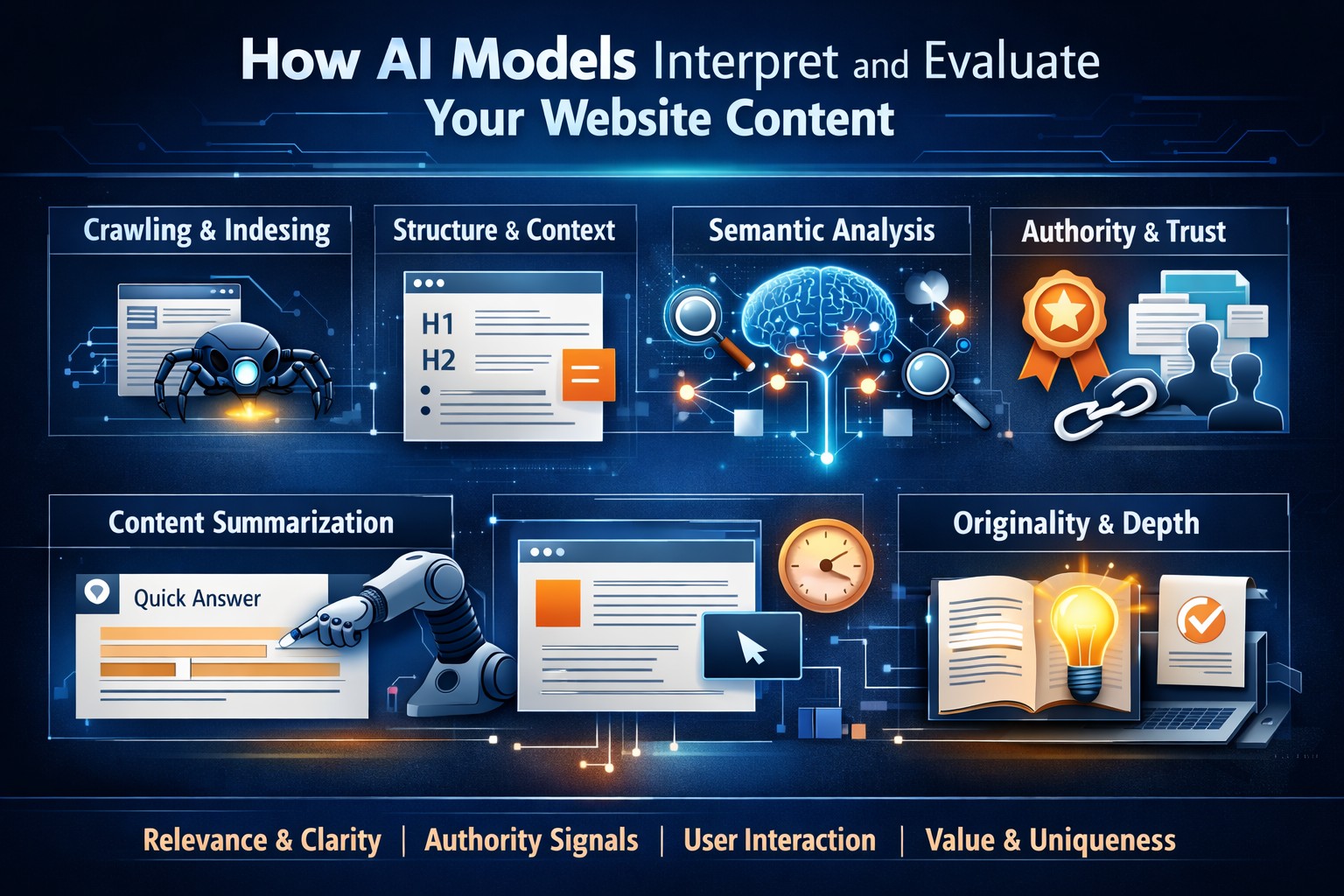
How AI Models Interpret and Evaluate Your Website Content
AI models are no longer just powering chatbots and recommendation engines—they’re actively interpreting, ranking, summarizing, and evaluating your website content. Whether through search engines, AI assistants, or enterprise systems, your content is increasingly being read and assessed by machines before humans ever see it.
Understanding how AI models interpret your website content is now essential for visibility, credibility, and performance.
Step 1: Crawling and Indexing
Before AI can interpret your content, it must first access it. Search engines and AI-powered discovery systems use crawlers to scan publicly available pages. These crawlers collect:
Page structure (headings, links, metadata)
Textual content
Images and alt text
Schema markup
Internal and external link relationships
Content that is blocked by technical issues—such as poor site architecture, missing metadata, or heavy client-side rendering—may not be fully indexed or interpreted.
Technical accessibility is the foundation of AI visibility.
Step 2: Parsing Structure and Context
Once content is indexed, AI models analyze its structure. They look at how information is organized to understand meaning and hierarchy.
Key structural signals include:
Headings (H1, H2, H3)
Bullet points and lists
Paragraph flow
Clear topic segmentation
Well-structured content is easier for AI to interpret because it signals intent and organization. Disorganized content makes it harder for models to extract meaning accurately.
Step 3: Semantic Understanding (Not Just Keywords)
Modern AI models rely on natural language processing (NLP) to interpret meaning beyond simple keyword matching.
They evaluate:
Topic relevance and depth
Semantic relationships between phrases
Contextual intent (informational, transactional, navigational)
Clarity and coherence
This means keyword stuffing no longer works. AI models prioritize content that demonstrates topical authority, logical flow, and genuine informational value.
Your content is evaluated based on what it communicates, not just which words it contains.
Step 4: Authority and Trust Signals
AI-driven search systems increasingly assess content credibility. They evaluate signals that indicate expertise and trustworthiness, such as:
Quality backlinks from reputable domains
Clear authorship or brand authority
Consistent topical coverage
Up-to-date information
Low-quality, thin, or inconsistent content weakens authority signals. High-value, well-researched content strengthens them.
AI models are trained to favor content that appears reliable and aligned with user needs.
Step 5: User Engagement Signals
Although AI models interpret content directly, many systems also incorporate behavioral data.
Engagement signals may include:
Time spent on page
Bounce rates
Click-through rates
Return visits
These signals help AI systems understand whether users find your content useful. Content that answers questions clearly and keeps users engaged tends to perform better over time.
Step 6: Evaluating Content for AI Summaries and Answers
With the rise of AI-generated search results and answer engines, content is often summarized before being displayed.
AI models extract:
Concise definitions
Clear explanations
Step-by-step processes
Direct answers to specific questions
Content that provides structured, direct answers is more likely to be featured in AI-generated summaries or responses.
This is why clarity and specificity matter more than ever.
Step 7: Assessing Originality and Depth
Modern AI systems are increasingly sensitive to repetitive, derivative, or low-effort content. They evaluate whether your page adds unique value compared to other sources.
High-performing content often includes:
Original insights or perspectives
Specific examples
Clear, actionable takeaways
Comprehensive coverage of the topic
Superficial content is easier for AI to de-prioritize.
What This Means for Website Owners
If AI models are interpreting your website before humans do, your content strategy must align with how machines understand meaning.
To improve AI interpretation and evaluation:
Write for clarity and structure
Cover topics comprehensively, not shallowly
Avoid keyword manipulation
Keep content updated and accurate
Build authority through consistency and credibility
AI models reward usefulness, not tricks.
The Bigger Shift: From Optimization to Understanding
The most important shift is this: website optimization is no longer about gaming algorithms. It’s about making your content genuinely understandable—to both humans and machines.
AI systems are designed to simulate comprehension. The clearer, more structured, and more valuable your content is, the better it performs across search, AI assistants, and digital discovery channels.
Final Thoughts
AI models interpret and evaluate your website content through a combination of structure, semantics, authority, engagement, and clarity. As AI-driven discovery becomes dominant, your visibility depends on how well your content communicates meaning—not just how well it ranks.
The future of content performance belongs to websites that prioritize depth, structure, and genuine value. When your content is built to be understood, both humans and AI systems respond accordingly.
Read More: https://intentamplify.com/blog..../what-chatgpt-sees-w