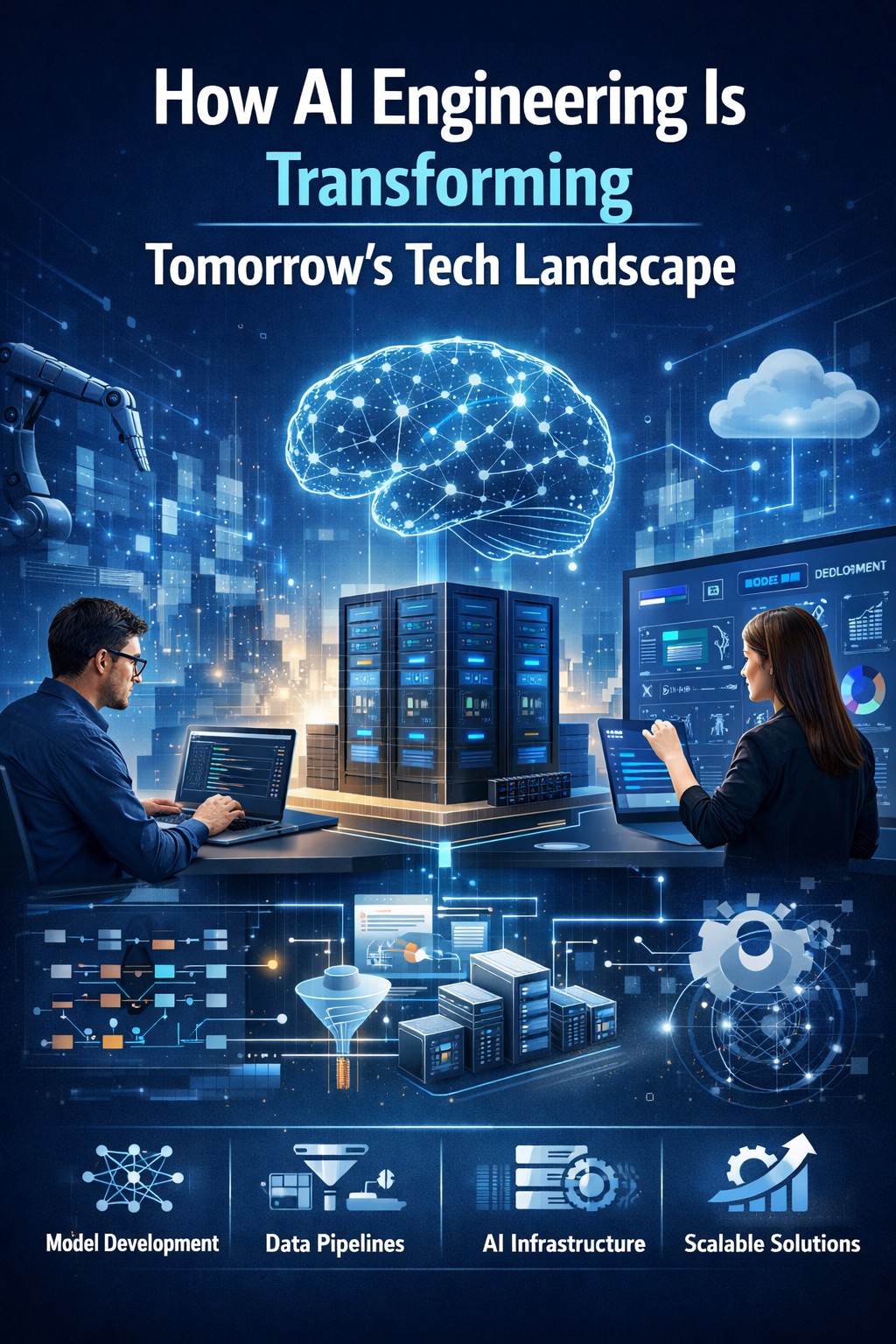
How AI Engineering Is Transforming Tomorrow’s Tech Landscape
Artificial intelligence is no longer just a research breakthrough or a product feature—it’s becoming a foundational engineering discipline. In 2025, AI engineering sits at the center of how modern technology is designed, built, and scaled. It blends software engineering, data science, infrastructure, and machine learning into a unified practice focused on delivering reliable AI systems in production.
The shift from experimentation to operational AI is reshaping the entire tech landscape.
From Research Models to Production Systems
In the early days of AI adoption, organizations focused heavily on building models. But models alone don’t create impact—systems do. AI engineering has emerged to bridge that gap.
AI engineers are responsible for:
Designing scalable model architectures
Building data pipelines that feed models reliably
Deploying models into real-world applications
Monitoring performance, drift, and reliability over time
This shift from model-centric thinking to system-centric thinking is transforming how companies approach innovation.
AI Becomes Core Infrastructure
AI is increasingly embedded into foundational systems rather than layered on top as an add-on. Recommendation engines, fraud detection, predictive analytics, generative tools, and autonomous workflows are now built directly into products and platforms.
AI engineering enables:
Seamless integration of models into user-facing applications
Real-time inference at scale
Hybrid cloud and edge deployments
Continuous retraining and optimization
In tomorrow’s tech landscape, AI won’t be a separate feature—it will be an underlying capability across industries.
The Rise of AI-Native Architecture
Traditional software architecture was not designed for probabilistic systems that learn and evolve. AI engineering introduces new patterns, including:
Model versioning and experimentation frameworks
Feature stores for consistent data management
Retrieval-augmented systems for contextual reasoning
Continuous evaluation pipelines
These architectural shifts are redefining DevOps into MLOps and, increasingly, LLMOps—disciplines focused on maintaining intelligent systems rather than static codebases.
AI Engineering Drives Product Reinvention
Beyond infrastructure, AI engineering is changing how products are imagined. Instead of building tools that require manual input for every action, teams are designing products that:
Anticipate user needs
Generate content or recommendations dynamically
Adapt interfaces based on behavior
Learn from user interactions over time
This creates products that evolve with users, fundamentally altering user experience expectations.
Talent and Skillset Transformation
The rise of AI engineering is also reshaping the workforce. Traditional boundaries between software engineers, data scientists, and operations teams are blurring.
Modern AI engineers combine:
Strong software development skills
Understanding of machine learning principles
Data architecture expertise
Knowledge of cloud and distributed systems
As demand grows, organizations are restructuring teams to support AI-first development.
Ethical and Responsible AI Engineering
As AI systems influence decisions at scale, engineering responsibility increases. AI engineering now includes governance, explainability, and bias mitigation as core components—not afterthoughts.
Tomorrow’s tech landscape will depend on:
Transparent model evaluation
Secure data handling
Compliance with regulatory frameworks
Clear human oversight in high-impact use cases
Trustworthy AI systems will define market leaders.
Continuous Learning Systems Replace Static Software
Traditional software follows deterministic rules. AI-powered systems learn continuously from data. This shift requires new monitoring strategies, including:
Tracking model drift over time
Evaluating performance across diverse user segments
Updating models safely without disrupting services
AI engineering transforms software from a fixed product into a dynamic, evolving service.
AI Infrastructure as Competitive Advantage
Infrastructure investments in GPUs, data platforms, model hosting, and orchestration tools are becoming strategic differentiators. Organizations with strong AI engineering capabilities can:
Innovate faster
Deploy features more quickly
Scale intelligently without instability
Tomorrow’s tech leaders will be defined not just by ideas, but by their ability to operationalize AI reliably.
The Broader Industry Impact
AI engineering is influencing every sector—from finance and healthcare to manufacturing and retail. Autonomous systems, intelligent automation, and generative applications are no longer experimental; they are core operational tools.
The companies shaping tomorrow’s tech landscape share a common trait: they treat AI engineering as a foundational discipline, not an experimental initiative.
Final Thoughts
AI engineering is transforming technology from static systems into adaptive, intelligent ecosystems. It bridges innovation and execution, ensuring that AI delivers measurable, scalable value.
As organizations continue embedding AI into the core of their platforms and products, the future of technology will be defined not just by smarter models—but by smarter engineering that makes those models reliable, ethical, and transformative.
About US:
AI Technology Insights (AITin) is the fastest-growing global community of thought leaders, influencers, and researchers specializing in AI, Big Data, Analytics, Robotics, Cloud Computing, and related technologies. Through its platform, AITin offers valuable insights from industry executives and pioneers who share their journeys, expertise, success stories, and strategies for building profitable, forward-thinking businesses
Read More: https://technologyaiinsights.c....om/how-ai-engineerin