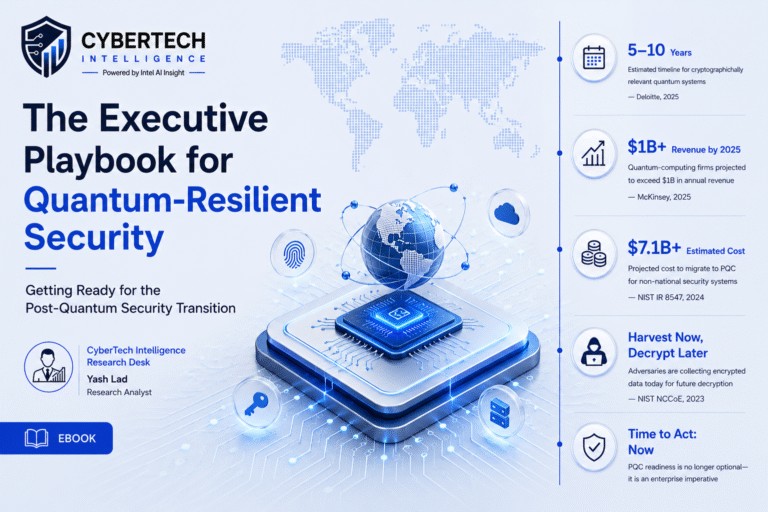
The Executive Reality of Quantum-Resilient Security: Why Enterprises Must Act Before the Threat Becomes Operational
Quantum computing is no longer a distant theoretical milestone confined to research labs and academic papers. It is steadily transitioning into a strategic cybersecurity concern that enterprise leaders can no longer afford to place in the “future risk” category.
The growing focus on Post-Quantum Cryptography (PQC) signals a fundamental shift in how digital trust will be built, maintained, and governed across industries. From financial systems and healthcare networks to cloud-native SaaS ecosystems and API-driven infrastructures, encryption sits at the core of modern digital operations. And that encryption is now entering a period of forced evolution.
The executive implications of this shift are captured in the core idea of quantum-resilient security readiness—a theme explored in depth in The Executive Playbook for Quantum-Resilient Security.
Read the Full Executive Playbook: https://tinyurl.com/3t3bt7xd
The Silent Risk Behind Today’s Encryption Systems
Most enterprise systems today still rely on classical cryptographic algorithms such as RSA and elliptic curve cryptography (ECC). These systems have been the backbone of digital security for decades, securing everything from online banking to enterprise identity frameworks.
However, the emergence of quantum computing research has introduced a long-term but highly credible risk: the ability of future quantum machines to break widely used encryption methods.
This creates a unique cybersecurity paradox. Data encrypted today may remain secure for years under current conditions—but could potentially become vulnerable in the future once quantum capabilities mature.
This is the foundation of the growing “harvest now, decrypt later” concern, where adversaries store encrypted data today with the intention of decrypting it later when quantum systems become powerful enough.
Industries dealing with long-lived sensitive data—such as healthcare, financial services, government, and defense—face the highest exposure.
Post-Quantum Cryptography Is Becoming a Strategic Priority
The cybersecurity landscape is already responding. The U.S. National Institute of Standards and Technology (NIST) has introduced the first generation of standardized post-quantum cryptographic algorithms, including ML-KEM, ML-DSA, and SLH-DSA.
These developments mark a turning point: quantum-resistant encryption is no longer experimental—it is entering production readiness.
Organizations are now shifting focus from “if” quantum migration will happen to “how fast” they can adapt.
At the executive level, this is no longer just a security engineering issue. It is a business continuity and infrastructure modernization challenge.
The Real Challenge: Enterprise Complexity, Not Just Encryption
While PQC provides a technical solution, the operational reality inside enterprises is significantly more complex.
Most organizations do not operate in clean, centralized environments. Instead, cryptography is deeply embedded across:
• Cloud infrastructure and hybrid deployments
• APIs and microservices architectures
• SaaS ecosystems and third-party integrations
• Legacy enterprise applications
• Identity and access management systems
• VPNs, certificates, and authentication layers
The biggest challenge is not replacing encryption algorithms—it is finding where they exist in the first place.
Many enterprises lack complete cryptographic visibility. Systems evolve over years, sometimes decades, resulting in:
• Hidden or undocumented encryption dependencies
• Certificate sprawl across environments
• Legacy systems with hardcoded cryptographic methods
• Fragmented ownership across teams and vendors
This makes migration planning both technically and operationally complex.
Why Executive Leadership Must Care Now
Quantum resilience is rapidly evolving into a board-level topic because it directly intersects with:
• Regulatory compliance expectations
• Enterprise risk management frameworks
• Customer trust and brand integrity
• Long-term data protection obligations
• Third-party and vendor ecosystem dependencies
Unlike traditional cybersecurity upgrades, PQC migration is not a single event. It is a multi-year transformation that must be integrated into infrastructure refresh cycles, cloud modernization strategies, and Zero Trust architecture initiatives.
Delaying preparation does not eliminate the risk—it compresses the timeline later, often leading to reactive and expensive transitions.
Compliance Pressure and the Economics of Delay
Regulatory bodies and cybersecurity agencies are increasingly emphasizing cryptographic resilience and long-term preparedness.
This means future compliance assessments are likely to evaluate not just whether encryption exists, but whether organizations are capable of transitioning to quantum-safe systems.
From a financial perspective, the difference between early planning and delayed response is significant.
Early-stage planning allows organizations to:
• Align migration with existing infrastructure upgrades
• Spread costs across multiple planning cycles
• Reduce operational disruption
• Avoid emergency technology replacements
Delayed action, on the other hand, typically results in accelerated deployments, higher consulting costs, and increased operational risk.
Building a Practical Migration Strategy
A successful PQC transition is not a direct replacement exercise. It is a phased transformation that typically begins with cryptographic discovery.
Organizations must first understand:
• Where cryptography exists across systems
• Which assets store long-term sensitive data
• Which vendors support quantum-safe alternatives
• Where high-risk dependencies are concentrated
Once visibility improves, enterprises can prioritize migration based on risk exposure.
High-priority systems often include:
• Identity and authentication systems
• Financial and payment platforms
• Customer-facing applications
• Critical infrastructure APIs
• Intellectual property repositories
Hybrid cryptographic models are emerging as a transitional strategy, combining classical and post-quantum algorithms to maintain interoperability while reducing risk exposure.
Crypto Agility: The Core Capability for the Quantum Era
One of the most important concepts emerging from the PQC transition is crypto agility—the ability to adapt cryptographic systems without large-scale disruption.
In traditional environments, cryptographic changes are slow, expensive, and operationally risky. Crypto agility changes this model by enabling:
• Faster algorithm replacement
• Reduced system downtime during upgrades
• Improved resilience to future cryptographic vulnerabilities
• Better alignment with evolving standards and regulations
In the long term, crypto agility will become a defining capability of mature cybersecurity architectures.
Security as a Competitive Advantage
Quantum readiness is not just about risk mitigation—it is increasingly becoming a competitive differentiator.
Organizations that demonstrate strong cryptographic resilience are better positioned to:
• Win enterprise contracts with strict security requirements
• Build stronger customer trust
• Accelerate procurement cycles
• Enter regulated markets more easily
• Strengthen long-term brand reputation
In an era where cybersecurity maturity is directly tied to business credibility, PQC readiness is evolving into a strategic advantage.
Final Takeaway
Quantum computing is reshaping the future of cryptographic trust. While fully operational quantum threats may still be emerging, the migration journey toward post-quantum security must begin now.
Enterprises that delay planning risk facing compressed timelines, higher costs, and operational instability when the transition becomes unavoidable.
Those that act early gain something far more valuable: control over the transformation process itself.
Read the Full Executive Playbook: https://tinyurl.com/3t3bt7xd