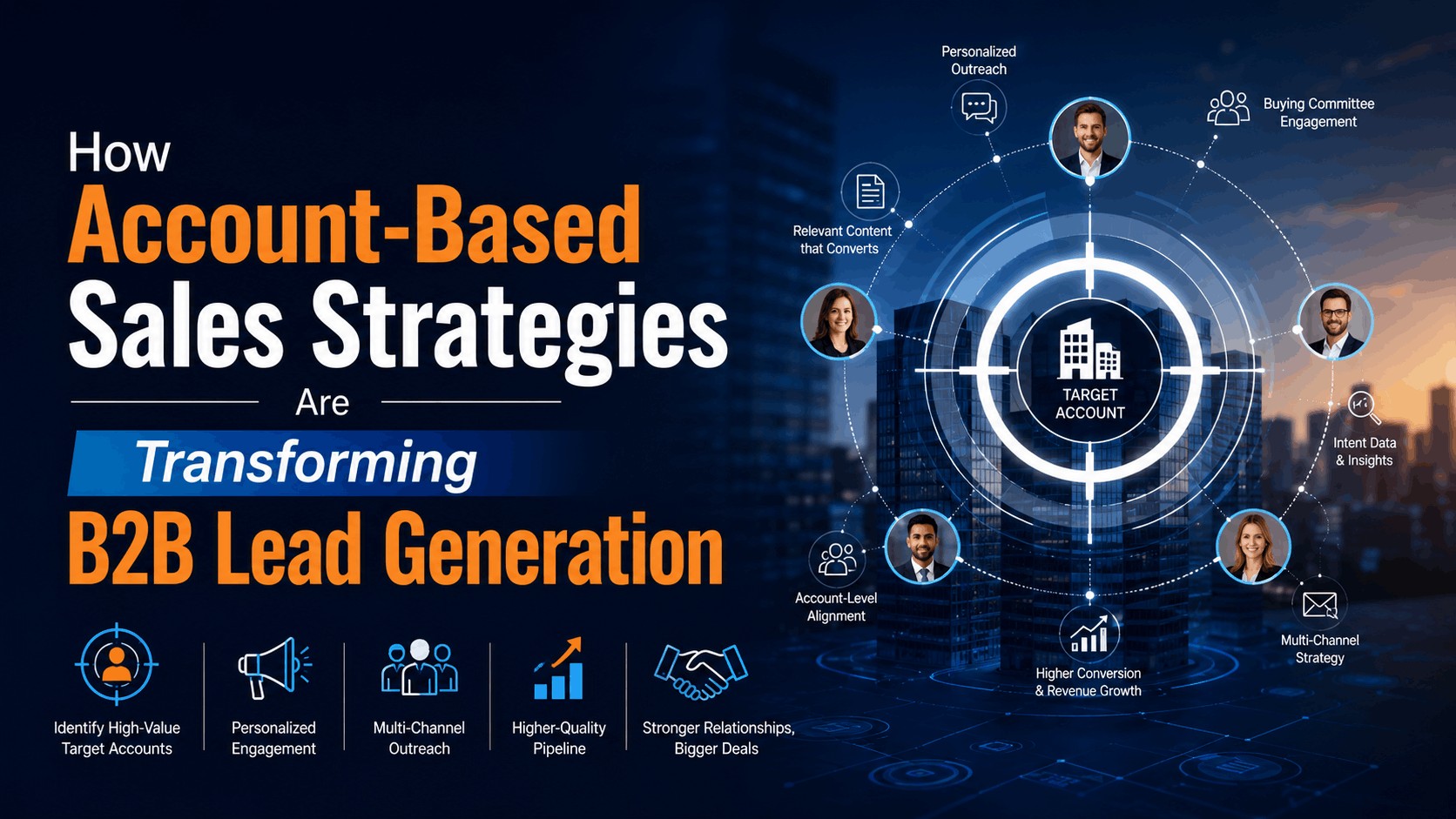
How Account-Based Sales Strategies Are Transforming B2B Lead Generation
The B2B sales landscape is changing rapidly. Traditional lead generation models that focused heavily on volume-based outreach are no longer delivering the same level of engagement, conversion efficiency, or pipeline quality that modern enterprises expect. Today’s buyers are more informed, more selective, and increasingly resistant to generic sales messaging.
As a result, organizations are shifting toward more personalized, data-driven, and account-focused approaches to customer acquisition. One of the most significant strategies driving this transformation is Account-Based Sales (ABS).
Account-Based Sales strategies are redefining how B2B organizations identify, engage, and convert high-value accounts. Instead of targeting large numbers of broad leads, businesses are concentrating their efforts on specific accounts that align closely with their ideal customer profiles. This targeted approach enables sales and marketing teams to create highly personalized experiences that improve engagement and accelerate revenue growth.
In today’s competitive enterprise environment, account-based strategies are becoming more than just a sales tactic — they are evolving into a core growth framework for modern B2B organizations.
The Shift Away from Traditional Lead Generation
For years, B2B lead generation focused primarily on generating high lead volumes through cold outreach, mass email campaigns, gated content, and broad marketing funnels. While these methods helped build large prospect databases, they often produced inconsistent conversion rates and lengthy sales cycles.
Modern buyers now expect highly relevant interactions tailored to their business challenges, industry priorities, and operational goals. Generic outreach campaigns frequently fail to capture attention because decision-makers are overwhelmed with repetitive sales messaging across digital channels.
This shift in buyer behavior has forced organizations to rethink how they approach lead generation.
Account-Based Sales strategies address this challenge by prioritizing quality over quantity. Instead of chasing every possible lead, businesses identify strategic accounts with the highest revenue potential and build personalized engagement plans around them.
This approach allows sales teams to focus resources more efficiently while improving overall conversion performance.
Why Account-Based Sales Is Gaining Momentum
Several market trends are accelerating the adoption of account-based strategies across enterprise sales organizations.
Increased Buying Committee Complexity
B2B purchasing decisions now involve multiple stakeholders across departments, including IT, security, finance, procurement, and executive leadership teams. Reaching a single contact is no longer enough to influence purchasing decisions.
Account-Based Sales enables organizations to engage multiple decision-makers within target accounts through coordinated and personalized outreach strategies.
Growth of Intent Data and AI Analytics
Modern sales platforms now provide advanced intent intelligence, behavioral analytics, and predictive insights that help organizations identify accounts actively researching solutions.
These technologies allow sales teams to prioritize accounts showing strong buying signals, improving targeting accuracy and increasing engagement opportunities.
AI-driven analytics also help organizations personalize messaging at scale, making account-based engagement more efficient and data-driven.
Alignment Between Sales and Marketing
Traditional lead generation models often created disconnects between sales and marketing teams. Marketing focused on lead volume while sales prioritized revenue opportunities.
Account-Based Sales strategies encourage stronger collaboration by aligning both teams around shared target accounts, engagement metrics, and pipeline goals.
This alignment improves campaign consistency, reduces operational silos, and enhances customer experiences throughout the buying journey.
How Account-Based Strategies Improve Lead Quality
One of the biggest advantages of Account-Based Sales is the ability to improve lead quality significantly.
Instead of generating thousands of unqualified leads, organizations focus on accounts that match their ideal customer profile based on factors such as:
• Industry vertical
• Company size
• Revenue potential
• Technology environment
• Geographic market
• Operational challenges
• Buying intent signals
This targeted approach helps businesses allocate resources toward opportunities with higher conversion potential.
Personalized outreach also increases engagement rates because messaging is tailored specifically to the account’s business priorities and pain points. Buyers are far more likely to respond to relevant, industry-specific conversations than generic sales pitches.
As a result, organizations often experience:
• Higher conversion rates
• Faster sales cycles
• Improved customer relationships
• Increased deal sizes
• Better pipeline predictability
• Higher return on marketing investment
The Role of Personalization in Modern B2B Sales
Personalization has become a defining factor in successful B2B engagement strategies.
Today’s enterprise buyers expect vendors to understand their business environment, operational goals, and industry challenges before initiating conversations. Account-Based Sales strategies support this expectation by enabling highly customized outreach across multiple touchpoints.
This may include:
• Personalized email campaigns
• Industry-specific content
• Customized webinars and events
• Tailored case studies
• Executive-level engagement strategies
• Multi-channel outreach campaigns
Advanced AI and automation platforms are making it easier for organizations to scale personalization while maintaining consistency across sales and marketing efforts.
Rather than relying on mass communication, businesses are now building more meaningful relationships with target accounts through relevant and value-driven engagement.
The Future of Account-Based Lead Generation
As digital transformation continues reshaping enterprise buying behavior, Account-Based Sales strategies are expected to play an even larger role in B2B growth initiatives.
Organizations are increasingly investing in AI-powered sales intelligence platforms, intent-based targeting solutions, predictive analytics, and revenue orchestration technologies to strengthen account-based engagement.
The future of B2B lead generation will likely focus less on maximizing lead quantity and more on building deeper relationships with high-value accounts.
Businesses that successfully combine personalization, intent intelligence, data analytics, and sales-marketing alignment will be better positioned to improve pipeline performance and accelerate long-term revenue growth.
In an increasingly competitive B2B environment, Account-Based Sales is no longer just a trend — it is becoming a strategic necessity for organizations seeking higher-quality engagement, stronger customer relationships, and more predictable business outcomes.
Read More: https://tinyurl.com/yupkcpad