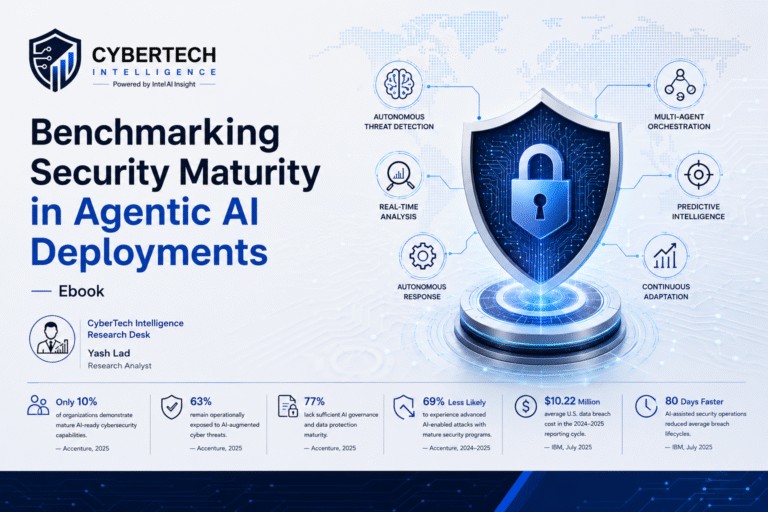
Benchmarking Security Maturity in Agentic AI Deployments
Agentic AI is quickly transforming the enterprise technology landscape. Organizations across industries are deploying autonomous AI agents to streamline workflows, automate decision-making, improve operational efficiency, and enhance cybersecurity response capabilities. Unlike traditional AI systems that require constant human direction, agentic AI systems can independently plan, reason, and execute tasks across enterprise environments.
This growing autonomy is opening new opportunities for innovation but it is also introducing a new category of cybersecurity and governance challenges.
As enterprises accelerate AI adoption, many security leaders are realizing that traditional security models are not fully designed to manage autonomous AI ecosystems. Questions around governance, identity management, access control, monitoring, compliance, and operational visibility are becoming critical boardroom discussions.
The real issue is no longer whether organizations should adopt AI. The focus is now shifting toward whether enterprises are mature enough to secure AI systems operating with increasing levels of autonomy.
Modern agentic AI deployments often interact with sensitive enterprise systems, business applications, APIs, cloud platforms, and internal data repositories. Without proper security maturity frameworks, organizations may unintentionally expose themselves to operational disruption, compliance risks, data leakage, or unauthorized AI-driven actions.
Many enterprises are still in the early stages of understanding how to benchmark AI security readiness. Some organizations have advanced AI adoption strategies but limited governance visibility. Others have strong cybersecurity programs but lack AI-specific risk assessment models. This gap between innovation and security maturity is becoming one of the biggest challenges in enterprise AI adoption today.
Organizations are now recognizing that AI agents should not be treated as simple software tools. They function more like digital operators that require governance, policy enforcement, continuous monitoring, and risk management controls.
Why Security Maturity Benchmarking Matters
Security maturity benchmarking helps organizations evaluate how prepared they are to deploy and manage agentic AI securely at scale. It provides a structured framework for identifying operational gaps, governance weaknesses, and security blind spots before they evolve into enterprise-wide risks.
Without maturity benchmarking, organizations may struggle with:
• Inconsistent AI governance policies
• Limited visibility into AI agent activities
• Weak authentication and access controls
• Poor monitoring of autonomous workflows
• Inadequate compliance alignment
• Increased exposure to prompt manipulation and AI misuse
• Difficulty scaling AI securely across departments
As autonomous AI systems gain broader enterprise access, the risks associated with unmanaged deployments continue to grow. AI agents interacting with financial systems, customer data, cloud infrastructure, or internal business processes can create significant security concerns if governance frameworks are not properly established.
Forward-thinking enterprises are beginning to integrate AI security maturity assessments into their broader cybersecurity and digital transformation strategies. These assessments help security teams evaluate not only technical controls, but also organizational readiness, policy maturity, operational resilience, and long-term governance capabilities.
Explore the complete eBook:
Benchmarking Security Maturity in Agentic AI Deployments
https://tinyurl.com/4kfx2am7
Key Areas Enterprises Must Evaluate
Governance and Accountability
One of the most important aspects of AI security maturity is governance. Organizations need clear ownership structures for AI systems, defined approval processes, and enterprise-wide governance standards that align with cybersecurity objectives.
Without accountability, AI deployments can quickly become fragmented across business units, increasing operational complexity and security exposure.
Identity and Access Management
AI agents often require access to enterprise systems, APIs, cloud platforms, and business applications. Applying least-privilege access principles is critical to minimizing unnecessary permissions and reducing potential attack surfaces.
Enterprises must ensure that AI systems operate within tightly controlled identity frameworks, with continuous authentication and role-based access controls.
Observability and Monitoring
Continuous monitoring is essential for understanding how AI agents behave across enterprise environments. Security teams need visibility into AI actions, system interactions, workflow decisions, and anomalous activities.
Strong observability frameworks help organizations detect misuse, unauthorized behavior, or operational failures before they escalate into major incidents.
Threat Modeling and Risk Assessments
Traditional threat modeling approaches may not fully account for autonomous AI behavior. Enterprises need updated risk assessment frameworks specifically designed for agentic AI environments.
This includes evaluating risks related to prompt injection, AI manipulation, model abuse, excessive permissions, insecure integrations, and third-party dependencies.
Compliance and Regulatory Alignment
As global AI regulations continue evolving, organizations must ensure that their AI deployments align with cybersecurity frameworks, privacy laws, and governance requirements.
Security maturity benchmarking helps enterprises identify compliance gaps and prepare for future regulatory expectations surrounding AI accountability and operational transparency.
The Shift Toward Secure AI Innovation
Organizations are increasingly realizing that AI innovation and cybersecurity can no longer operate as separate functions. AI security maturity is becoming a foundational requirement for scaling enterprise AI responsibly.
Businesses that invest early in governance, visibility, monitoring, and operational resilience will likely be better positioned to deploy AI securely while maintaining stakeholder trust.
At the same time, enterprises that overlook security maturity may face growing operational and reputational risks as autonomous AI adoption expands.
The next phase of enterprise AI will not simply be defined by how advanced AI systems become — it will be defined by how securely organizations can manage them.
Security maturity benchmarking offers enterprises a clearer path toward responsible AI adoption, helping organizations balance innovation, governance, and resilience in increasingly autonomous digital environments.
Read More
Gain deeper insights into enterprise AI governance, security readiness, and operational resilience in the full eBook:
Benchmarking Security Maturity in Agentic AI Deployments
https://tinyurl.com/4kfx2am7