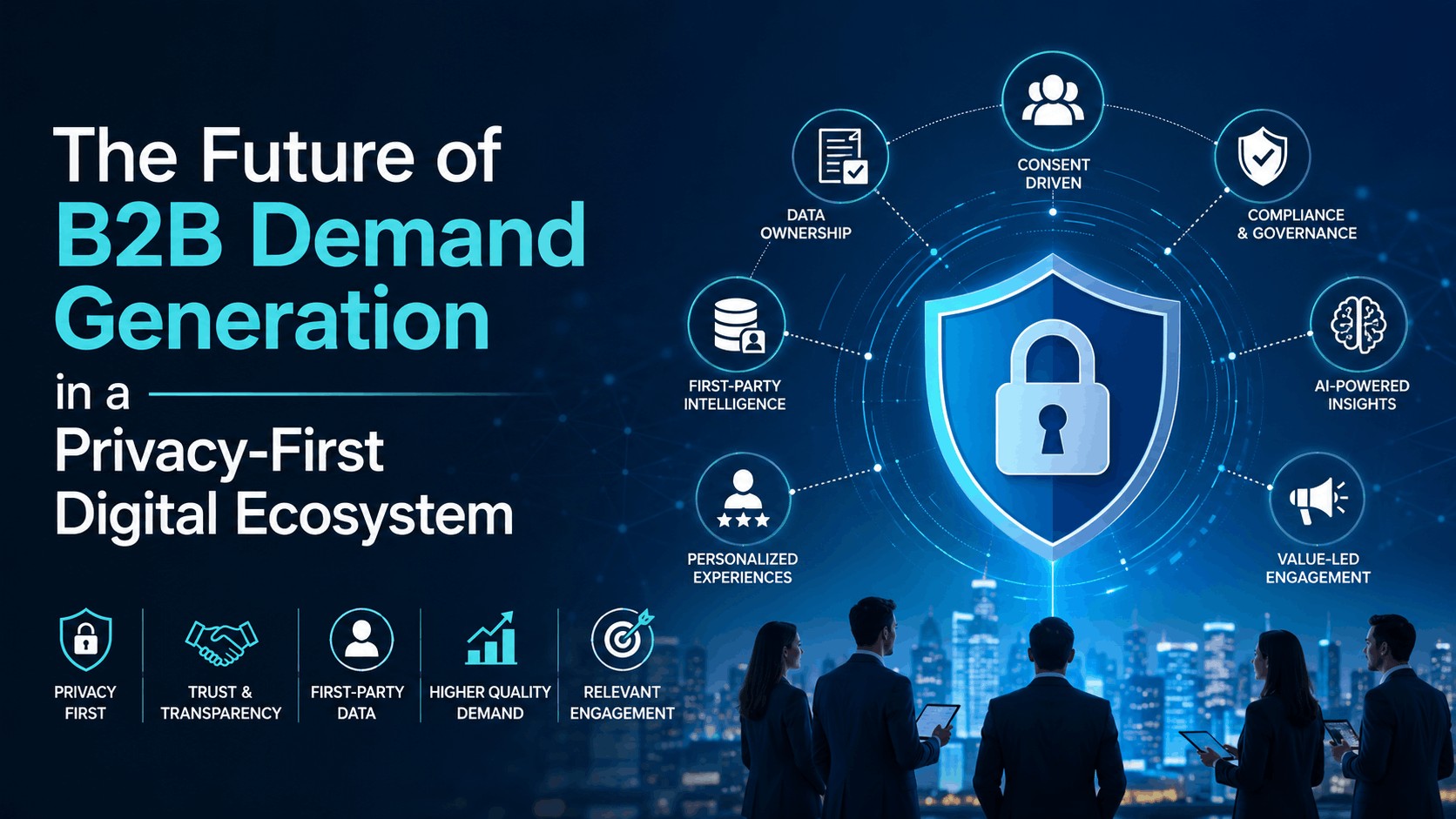
The Future of B2B Demand Generation in a Privacy-First Digital Ecosystem
For years, B2B demand generation has been fueled by unrestricted data collection, third-party cookies, and large-scale behavioral tracking. Marketers relied heavily on external datasets to build audience profiles, personalize outreach, and scale lead acquisition across digital channels. That model, however, is rapidly changing. A combination of global privacy regulations, growing buyer awareness, and evolving technology standards is forcing enterprises to rethink how they generate, nurture, and convert demand.
The shift toward a privacy-first digital ecosystem is not simply a compliance challenge. It represents a structural transformation in how B2B organizations build trust, collect intent signals, and engage enterprise buyers. In this new environment, demand generation strategies are moving away from volume-driven targeting toward consent-based engagement, first-party intelligence, and value-led customer experiences.
At the center of this transformation is a growing realization: data ownership and transparency are becoming competitive differentiators. Enterprise buyers are more conscious than ever about how their information is collected, stored, and used. As a result, organizations that prioritize ethical data practices are increasingly gaining stronger engagement rates, higher-quality leads, and longer-term customer relationships.
One of the biggest drivers behind this shift is the decline of third-party cookies and broad-spectrum audience tracking. Traditional B2B advertising ecosystems relied heavily on external data brokers and retargeting mechanisms that allowed marketers to follow users across websites and platforms. But with browsers tightening tracking restrictions and governments introducing stricter data protection frameworks, those methods are becoming less reliable and less sustainable.
This change is pushing B2B marketers toward first-party and zero-party data strategies. First-party data includes information collected directly from prospects through website interactions, webinars, gated content, CRM engagement, and customer conversations. Zero-party data goes a step further, involving information intentionally shared by users, such as preferences, purchase intent, or business priorities. These datasets are proving to be more accurate, more compliant, and more valuable than traditional third-party alternatives.
As a result, content is becoming increasingly important in modern demand generation. Instead of relying on aggressive targeting alone, enterprises are focusing on creating high-value experiences that encourage buyers to willingly share information. Thought leadership articles, research reports, webinars, executive roundtables, and industry-specific insights are now central to lead acquisition strategies because they establish trust before data collection even begins.
This evolution is also changing how intent data is used in B2B marketing. Previously, many intent platforms depended heavily on broad behavioral monitoring across the web. Today, intent strategies are becoming more contextual and relationship-driven. Organizations are combining first-party engagement metrics with consent-based behavioral insights to better understand where buyers are in the decision-making process.
The rise of AI-powered marketing platforms is further accelerating this transition. Artificial intelligence is helping enterprises analyze engagement patterns, predict customer interests, and personalize outreach without relying excessively on invasive tracking mechanisms. Instead of monitoring every digital movement, AI systems are increasingly focused on interpreting declared interests, interaction quality, and content engagement trends.
This is especially important in enterprise sales environments where trust and credibility directly influence buying decisions. In B2B markets, purchasing cycles are longer, stakeholders are more diverse, and decision-making processes are more complex. Privacy-centric engagement strategies can therefore improve not only compliance posture but also overall sales efficiency.
Another major development reshaping demand generation is the growing importance of data governance. Marketing teams can no longer operate independently from cybersecurity, compliance, and legal departments. Enterprise organizations are now building integrated frameworks that align demand generation activities with broader governance policies. This includes consent management systems, transparent data usage disclosures, secure customer data storage, and clear opt-in mechanisms.
These governance initiatives are becoming essential because privacy regulations continue to expand globally. Laws such as GDPR, CCPA, and emerging regional data protection standards are redefining acceptable marketing practices. For multinational B2B organizations, compliance is no longer optional — it is becoming a foundational requirement for maintaining customer trust and protecting brand reputation.
At the same time, privacy-first demand generation is influencing advertising technology investments. Many enterprises are reallocating budgets away from mass-scale programmatic advertising toward account-based marketing (ABM), community engagement, and industry-specific audience development. These approaches prioritize relevance and relationship-building over broad targeting volume.
Account-based marketing, in particular, aligns naturally with privacy-first strategies because it focuses on engaging clearly identified organizations rather than anonymous individuals. By targeting known accounts with personalized content and contextual messaging, enterprises can reduce dependence on invasive data collection while improving conversion quality.
The future of B2B demand generation will also depend heavily on transparency. Buyers increasingly expect organizations to explain why data is being collected and how it will be used. Companies that communicate this clearly are likely to experience stronger trust and higher engagement rates. Transparency is no longer just a legal checkbox — it is becoming part of the customer experience itself.
Additionally, partnerships between publishers, data providers, and enterprise marketers are evolving to support compliant audience engagement. Trusted content ecosystems and permission-based syndication models are emerging as more sustainable alternatives to traditional lead-generation methods. These models emphasize audience relevance, contextual alignment, and user consent rather than excessive behavioral surveillance.
Looking ahead, the most successful B2B demand generation strategies will likely combine privacy, intelligence, and personalization in balanced ways. Organizations will continue investing in AI-driven analytics and intent modeling, but the focus will increasingly shift toward ethical engagement and trusted relationships rather than unrestricted data harvesting.
This transition may initially appear restrictive for marketers accustomed to older targeting methods. In reality, however, it is creating opportunities for higher-quality engagement. Privacy-first demand generation encourages businesses to build stronger value propositions, produce more meaningful content, and establish authentic connections with buyers.
Ultimately, the future of B2B demand generation is not about collecting more data. It is about building smarter, more transparent, and more trusted engagement ecosystems. Enterprises that adapt early to this shift will be better positioned to navigate evolving regulations, strengthen buyer confidence, and create sustainable long-term growth in an increasingly privacy-conscious digital economy.
Read More: https://intentamplify.com/blog..../data-ownership-and-