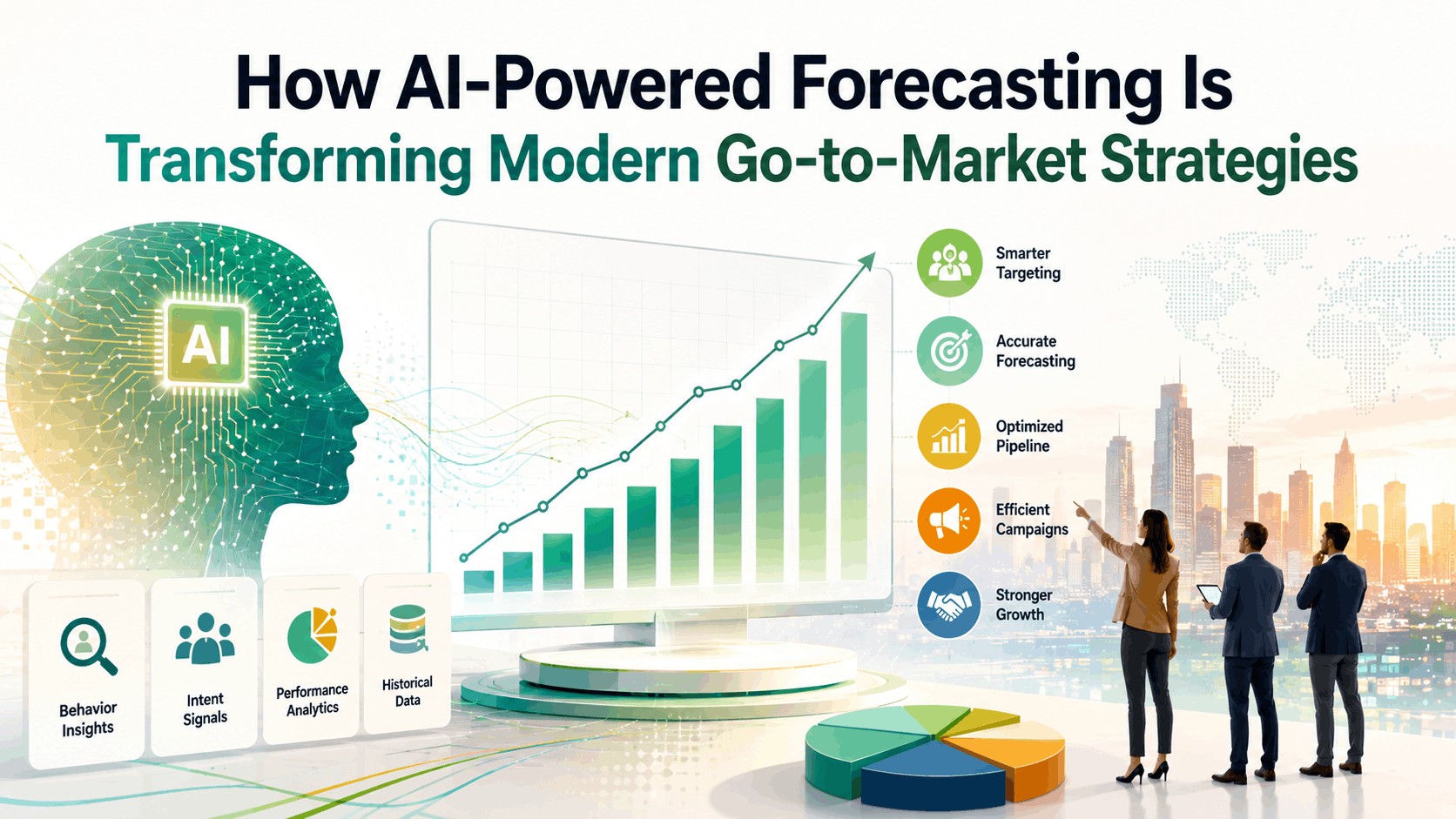
How AI-Powered Forecasting Is Transforming Modern Go-to-Market Strategies
Go-to-market strategies are undergoing a major transformation as artificial intelligence becomes deeply integrated into modern revenue operations. In 2026, businesses are no longer relying solely on historical reports, static CRM data, or manual forecasting models to guide sales and marketing decisions. Instead, organizations are increasingly adopting AI-powered forecasting systems capable of analyzing massive datasets, identifying buying patterns, and predicting revenue outcomes with far greater accuracy.
This shift is changing how revenue teams plan campaigns, prioritize accounts, allocate budgets, and engage buyers across the entire customer journey.
AI-powered forecasting is no longer just a reporting enhancement. It is becoming a strategic engine driving next-generation go-to-market execution.
The Evolution of Go-to-Market Strategy
Traditional go-to-market (GTM) models were often built around reactive decision-making. Revenue teams would analyze past performance, evaluate quarterly results, and adjust strategies based on lagging indicators.
While these methods provided useful insights, they often struggled to keep pace with rapidly changing buyer behavior and increasingly competitive digital markets.
Modern B2B buyers move quickly, consume information independently, and interact across multiple digital channels before engaging with sales teams. This complexity has created a growing need for real-time intelligence capable of identifying opportunities before they become visible through traditional analytics.
AI-powered forecasting addresses this challenge by transforming GTM planning from retrospective analysis into predictive decision-making.
Instead of simply measuring what already happened, businesses can now anticipate future buying behavior, market trends, and revenue opportunities more effectively.
AI Is Reshaping Revenue Forecasting
One of the biggest advantages of AI forecasting is its ability to process enormous volumes of structured and unstructured data simultaneously.
Modern AI platforms analyze:
• CRM activity
• Buyer intent signals
• Website engagement
• Sales interactions
• Market trends
• Historical deal performance
• Product usage data
• Customer behavior patterns
• Economic indicators
By combining these variables, machine learning models can generate highly accurate revenue forecasts and pipeline predictions.
Unlike traditional forecasting methods that rely heavily on human assumptions, AI systems continuously refine predictions based on real-time data changes. This creates more dynamic forecasting environments capable of adapting quickly to evolving market conditions.
For revenue teams, this means better visibility into future pipeline health and improved confidence in strategic planning.
Predictive GTM Is Improving Pipeline Efficiency
Pipeline efficiency has become one of the primary areas where AI forecasting is delivering measurable impact.
Many organizations struggle with pipeline inconsistencies caused by inaccurate lead scoring, poor targeting, and delayed sales engagement. AI-driven forecasting platforms help solve these problems by identifying high-probability opportunities earlier in the buying cycle.
These systems can determine:
• Which accounts are most likely to convert
• Which deals face elevated risk
• Which channels generate the highest ROI
• Which customer segments show expansion potential
• Which campaigns are likely to underperform
This predictive visibility allows sales and marketing teams to focus resources more effectively.
Instead of relying on broad outreach strategies, organizations can prioritize accounts and buyers demonstrating strong purchase intent and engagement behavior. This improves conversion rates while reducing wasted operational effort.
AI Is Driving Smarter Sales and Marketing Alignment
Sales and marketing alignment has long been a challenge for enterprise revenue teams. Disconnected systems, inconsistent metrics, and fragmented data often create inefficiencies that impact pipeline growth.
AI forecasting platforms are helping unify these functions through shared intelligence and predictive insights.
Revenue teams can now operate from centralized forecasting models that provide visibility into campaign performance, sales readiness, buyer engagement, and revenue projections in real time.
This alignment creates several important benefits:
Improved Lead Prioritization
AI helps identify which accounts are most likely to move through the pipeline successfully, allowing teams to prioritize outreach more strategically.
Better Campaign Optimization
Marketing teams can adjust messaging, content strategies, and targeting based on predictive engagement insights.
Faster Decision-Making
Real-time forecasting allows organizations to respond more quickly to market shifts and customer behavior changes.
More Accurate Revenue Planning
Leadership teams gain clearer visibility into future pipeline performance, helping improve budgeting and operational planning.
As revenue operations continue evolving, AI-powered forecasting is becoming central to cross-functional collaboration.
Intent Data and Predictive Analytics Are Converging
One of the most important developments in modern GTM strategy is the integration of buyer intent data with predictive forecasting systems.
Intent data provides visibility into which accounts are actively researching products, evaluating vendors, or engaging with relevant market topics. AI forecasting platforms combine these behavioral signals with historical performance data to predict future purchasing outcomes more accurately.
For example, if a target account begins showing increased engagement around cybersecurity automation, cloud migration, or AI governance topics, predictive systems can alert sales and marketing teams before competitors identify the opportunity.
This enables businesses to engage buyers during high-interest periods when purchase intent is strongest.
The result is a more proactive GTM approach centered around timing, personalization, and behavioral intelligence.
The Future of AI-Driven GTM Strategies
The future of go-to-market strategy will likely become increasingly autonomous, data-driven, and predictive.
AI-powered forecasting systems are expected to evolve beyond analytics into intelligent decision engines capable of recommending actions automatically. Future platforms may dynamically adjust campaign spending, prioritize sales engagement, optimize pricing strategies, and personalize buyer experiences in real time.
Generative AI is also expected to play a larger role in revenue operations by helping create customized messaging, automate research workflows, and improve strategic planning efficiency.
However, successful AI adoption will depend heavily on data quality, governance, and organizational alignment. Companies that build strong data infrastructure and integrate AI strategically across revenue functions will likely gain the greatest competitive advantage.
Conclusion
AI-powered forecasting is transforming modern go-to-market strategies by enabling businesses to move from reactive planning toward predictive revenue execution.
By combining machine learning, behavioral analytics, buyer intent data, and real-time intelligence, organizations can improve pipeline accuracy, optimize sales and marketing alignment, and accelerate revenue growth more effectively.
As enterprise markets become more competitive and buyer journeys grow increasingly complex, predictive GTM strategies powered by AI will become essential for long-term business success.
The next generation of high-performing revenue teams will not rely solely on historical reporting. They will operate on intelligent forecasting systems capable of predicting opportunities, reducing uncertainty, and driving faster, smarter growth decisions.
Read More: https://intentamplify.com/blog..../the-rise-of-predict