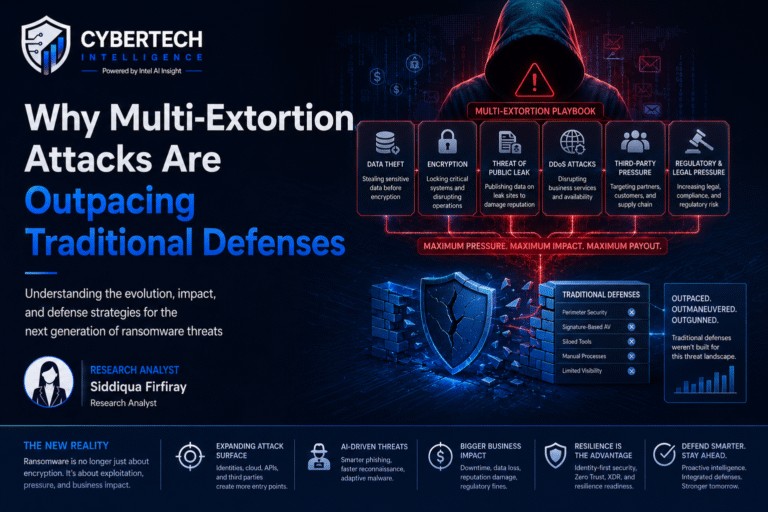
Multi-Extortion Attacks Are Outpacing Traditional Defenses - Why Enterprises Must Rethink Cyber Resilience
Cybercriminal operations are no longer relying on a single ransomware payload to pressure organizations into paying. Modern attacks have evolved into multi-layered extortion campaigns that combine encryption, data theft, public exposure threats, operational disruption, and even third-party pressure tactics. The result is a far more aggressive and psychologically targeted cybercrime model that is rapidly outpacing traditional enterprise defenses.
The latest expert analysis on multi-extortion attacks explores how ransomware groups are escalating pressure across every stage of the attack lifecycle — and why many organizations remain dangerously underprepared for this new generation of cyber threats.
Read the full expert analysis here:
https://tinyurl.com/mtynac3w
Ransomware Is No Longer Just About Encryption
For years, ransomware followed a relatively predictable model. Attackers infiltrated networks, encrypted systems, and demanded payment for decryption keys. But modern threat actors have realized that backups and recovery strategies have reduced the effectiveness of pure encryption-based attacks.
In response, cybercriminals evolved.
Today’s multi-extortion campaigns use several simultaneous pressure points to maximize leverage against victims. According to cybersecurity research, attackers now frequently combine data encryption with data exfiltration, DDoS threats, customer harassment, and reputational blackmail.
This transformation has fundamentally changed the economics of ransomware.
Even if an organization successfully restores systems from backups, attackers can still threaten to leak sensitive data publicly, contact customers directly, or disrupt operations through secondary attacks. That means recovery alone is no longer enough to neutralize business risk.
Why Traditional Security Models Are Failing
One of the most important themes highlighted in the expert analysis is that traditional cybersecurity architectures were not built for coordinated, multi-stage extortion operations.
Legacy defenses often operate in silos:
• Endpoint security handles malware
• Email security filters phishing
• Backup systems focus on recovery
• Identity tools monitor credentials
But multi-extortion attacks do not operate in isolated stages. They move fluidly across identity compromise, lateral movement, data theft, privilege escalation, and operational disruption simultaneously.
Security fragmentation creates blind spots that sophisticated attackers exploit aggressively. Industry experts increasingly warn that disconnected security environments reduce visibility and delay response times during active attacks.
The speed of modern attacks further compounds the problem. AI-assisted phishing, automated reconnaissance, and credential abuse are allowing attackers to accelerate intrusion timelines dramatically.
The Rise of Psychological and Reputational Extortion
What makes multi-extortion especially dangerous is that attackers are now targeting organizational pressure points beyond IT systems.
Threat actors increasingly understand:
• Brand reputation has financial value
• Regulatory exposure creates urgency
• Customer trust impacts market position
• Operational downtime affects shareholder confidence
As a result, ransomware groups are adopting tactics specifically designed to amplify executive pressure.
Modern campaigns may involve:
• Threatening public disclosure of sensitive data
• Contacting customers and partners directly
• Launching DDoS attacks during negotiations
• Leveraging media exposure as coercion
• Targeting executives with personalized intimidation
This evolution turns ransomware from a technical incident into a full-scale business crisis.
Research shows that double, triple, and even quadruple extortion strategies are becoming increasingly common across enterprise environments.
Identity Is Becoming the Primary Attack Surface
Another major shift discussed in the analysis is the growing role of identity compromise in ransomware operations.
Attackers are increasingly “logging in rather than breaking in.” Compromised credentials, session hijacking, and phishing-resistant MFA bypass techniques are enabling threat actors to move through environments while appearing legitimate.
This is especially concerning in hybrid cloud and SaaS-heavy enterprise environments where identity systems control access across multiple business-critical platforms.
Traditional perimeter-focused security models are struggling because the perimeter itself has effectively disappeared.
Instead, organizations now need:
• Continuous identity verification
• Zero-trust security architectures
• AI-driven behavioral analytics
• Unified visibility across environments
• Automated threat detection and containment
Recovery Alone Is No Longer Cyber Resilience
One of the strongest insights from the expert analysis is that resilience strategies must evolve beyond backup recovery.
Organizations often assume that immutable backups and disaster recovery plans are enough to survive ransomware attacks. But multi-extortion campaigns specifically target this assumption.
Attackers now aim to:
• Steal data before encryption
• Corrupt or locate backup systems
• Maintain persistence after restoration
• Re-attack organizations during recovery phases
• Use stolen information for long-term leverage
This means enterprises must rethink cyber resilience as a combination of:
• Prevention
• Detection
• Containment
• Recovery
• Communication readiness
• Reputation management
Cyber resilience is no longer just a technical discipline — it is now an operational business strategy.
Why Security Leaders Should Read This Analysis
The expert analysis on multi-extortion attacks provides valuable insight into how ransomware operations are evolving faster than many enterprise defense models.
For CISOs, risk leaders, SOC teams, and enterprise decision-makers, understanding this shift is essential for preparing security strategies that align with modern attack realities.
The article offers a timely examination of:
• Emerging ransomware tactics
• Multi-layered extortion strategies
• Identity-centric attack methods
• Weaknesses in traditional defenses
• The future of enterprise cyber resilience
Read the Full Expert Analysis Here:
https://tinyurl.com/mtynac3w